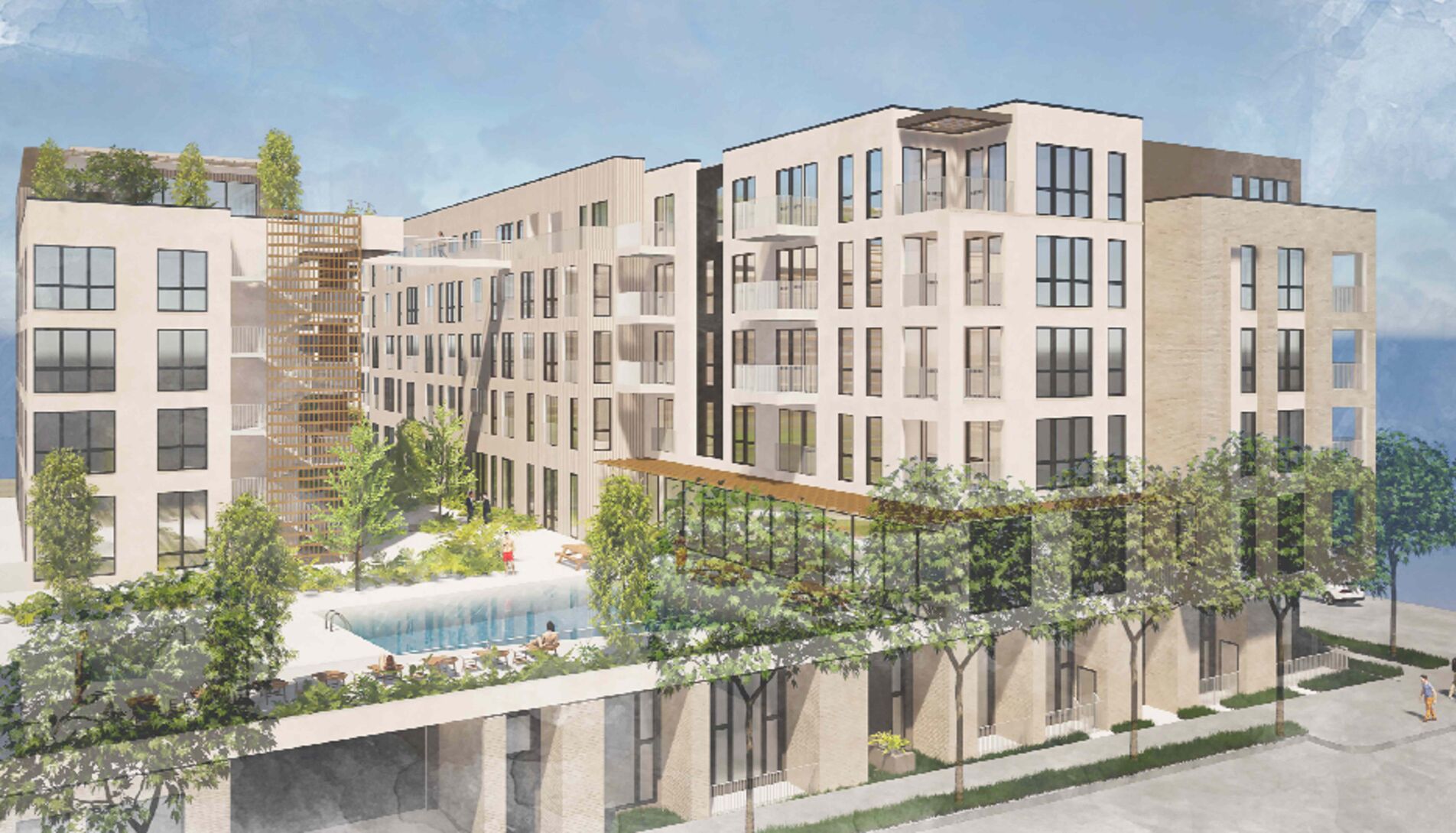
The San Mateo Planning Commission approved a six-story, 181-unit apartment building on North San Mateo Drive, advancing the city’s robust development pipeline, particularly in dense residential and commercial areas.
The project — spearheaded by the Prometheus Real Estate Group, which is also working on other developments in the area — will require demolition of two one-story commercial buildings that were a former Ford dealership and a two-story duplex to make way for the roughly 258,000-square-foot building in between Villa Terrace and State Street, at 715 and 723 N. San Mateo Drive. Out of the 181 units, the development will have 19 below-market-rate units.
Despite some community concerns around the parking spaces and potential impact in the surrounding area, the project is protected by a number of state laws that prohibit local jurisdictions from mandating a certain number of parking spaces, especially because it is located within a half mile of a Caltrain station. The project would comprise a two-level parking garage with 180 spaces.
"When it comes to housing projects, those decisions have largely been taken out of the hands of local jurisdictions,” Chair Seema Patel said during the meeting. “There's not a lot that the Planning Commission can do … to require certain changes or design guidelines of these projects."
Commissioner Maxwell Schaumkel added that he was supportive of the project, though the parking concerns are going to be “something that we constantly wrestle with” throughout the city.
Recommended for you
However, the development is also reflective of the changes made under Measure T, which passed in November 2024 and amended the city’s previous five-story building limit. Now, several parts of the city, including transit-rich corridors like downtown have higher building caps that make it easier for developers to build denser and taller buildings. As a result, the city has seen one of the highest influxes of multi-family residential development applications in the last two years in the county.
All cities in California must plan and issue permits for a certain number of housing units, as determined by the Department of Housing and Community Development, known as the Regional Housing Needs Assessment. During this current eight-year cycle, which ends in 2031, San Mateo must plan for at least 7,015 units. As of a recent City Council meeting, San Mateo’s development pipeline has reached 97% of its housing goals, though much of those have not yet been entitled.
At least six new developments have been proposed in just the last couple months in San Mateo, totaling more than 1,100 housing units.
The developments with the most units include the Hillsdale Shopping Center redevelopment, which will replace the mall with 1,670 new housing units and retail and office buildings, as well as the Concar Passage development that will construct 850 new housing units and some commercial space.
The commission approved the North San Mateo Drive project 4-0 during the meeting March 24.
Let me say first that I am in support of this project. I believe that it is close enough to both caltrain and El Camino which are my primary requirements for development.
But I'm curious about the metrics used to determine distance from caltrain. Google maps says this project is 0.6 miles from the nearest(Burlingame) station. And that is walking, biking, and driving. So this would not meet the half mile requirement. It's plausible that Google maps is not entirely accurate and that the state requirements uses a completely different metric. I do hope that "a crow's fly" is not being used. I definitely don't mean to be a stickler about a tenth of a mile. I'm more curious about the method.
These projects are commanded by Scott Weiner and the sheep who follow him. The is plenty the city can do to stop this but they won't demand these made up requirements be reversed. These are union job make work projects and provide no housing for people of modest means.
Sure - how did they come to be? A combination of Weiner and his cohorts, then action by this commission. All of that can be reversed the same way these edicts were created. These "rules" were not enshrined in the constitution, and even if it was, as often as that rag is amended, we could do it one more time. Bottom line is these rules were created by politicians and we are not forced to allow it to continue. If i thought these divine instructions actually accomplished creating housing for the moderate income folks, I would not be so opposed. However, they simply do not. We all pay the costs of this overbuilding of these huge projects and will long suffer in the changes in our communities.
You asked what cities can do and I did not answer you directly on that point. The city can call on the state legislative representatives to get to work to remove these rules. Think that will happen when the unions hear about it? It won't, but that does not mean we should all suffer to line their pockets.
Thank you for your answer. That all makes sense. And to your point, Portola Valley has considered dissolving itself to avoid RHNA requirements. And I fully support their fight. I think the RHNA was poorly designed. Every town is different and to require semi rural towns with no public transportation to develop on land that would could be open space or parks is nonsensical. I feel the same with land on the bay east of 101. The RHNA should have just focused housing as infill rather than expanding our metro.
Keep the discussion civilized. Absolutely NO
personal attacks or insults directed toward writers, nor others who
make comments. Keep it clean. Please avoid obscene, vulgar, lewd,
racist or sexually-oriented language. Don't threaten. Threats of harming another
person will not be tolerated. Be truthful. Don't knowingly lie about anyone
or anything. Be proactive. Use the 'Report' link on
each comment to let us know of abusive posts. PLEASE TURN OFF YOUR CAPS LOCK. Anyone violating these rules will be issued a
warning. After the warning, comment privileges can be
revoked.
Please purchase a Premium Subscription to continue reading.
To continue, please log in, or sign up for a new account.
We offer one free story view per month. If you register for an account, you will get two additional story views. After those three total views, we ask that you support us with a subscription.
A subscription to our digital content is so much more than just access to our valuable content. It means you’re helping to support a local community institution that has, from its very start, supported the betterment of our society. Thank you very much!







(8) comments
Let me say first that I am in support of this project. I believe that it is close enough to both caltrain and El Camino which are my primary requirements for development.
But I'm curious about the metrics used to determine distance from caltrain. Google maps says this project is 0.6 miles from the nearest(Burlingame) station. And that is walking, biking, and driving. So this would not meet the half mile requirement. It's plausible that Google maps is not entirely accurate and that the state requirements uses a completely different metric. I do hope that "a crow's fly" is not being used. I definitely don't mean to be a stickler about a tenth of a mile. I'm more curious about the method.
These projects are commanded by Scott Weiner and the sheep who follow him. The is plenty the city can do to stop this but they won't demand these made up requirements be reversed. These are union job make work projects and provide no housing for people of modest means.
Do you have examples of what municipalities can do to reverse a state mandate? Is it lawsuits? And if so, on what grounds?
Sure - how did they come to be? A combination of Weiner and his cohorts, then action by this commission. All of that can be reversed the same way these edicts were created. These "rules" were not enshrined in the constitution, and even if it was, as often as that rag is amended, we could do it one more time. Bottom line is these rules were created by politicians and we are not forced to allow it to continue. If i thought these divine instructions actually accomplished creating housing for the moderate income folks, I would not be so opposed. However, they simply do not. We all pay the costs of this overbuilding of these huge projects and will long suffer in the changes in our communities.
You asked what cities can do and I did not answer you directly on that point. The city can call on the state legislative representatives to get to work to remove these rules. Think that will happen when the unions hear about it? It won't, but that does not mean we should all suffer to line their pockets.
Thank you for your answer. That all makes sense. And to your point, Portola Valley has considered dissolving itself to avoid RHNA requirements. And I fully support their fight. I think the RHNA was poorly designed. Every town is different and to require semi rural towns with no public transportation to develop on land that would could be open space or parks is nonsensical. I feel the same with land on the bay east of 101. The RHNA should have just focused housing as infill rather than expanding our metro.
A CA State initiative is needed. The democrat government and the unions have too much power and will never give it up on their own.
We need more housing like this. Baa.
Welcome to the discussion.
Log In
Keep the discussion civilized. Absolutely NO personal attacks or insults directed toward writers, nor others who make comments.
Keep it clean. Please avoid obscene, vulgar, lewd, racist or sexually-oriented language.
Don't threaten. Threats of harming another person will not be tolerated.
Be truthful. Don't knowingly lie about anyone or anything.
Be proactive. Use the 'Report' link on each comment to let us know of abusive posts.
PLEASE TURN OFF YOUR CAPS LOCK.
Anyone violating these rules will be issued a warning. After the warning, comment privileges can be revoked.